Sunflowers and Ladybug Embroidery Design
First Impressions: A Cheerful, Balanced Nature Motif
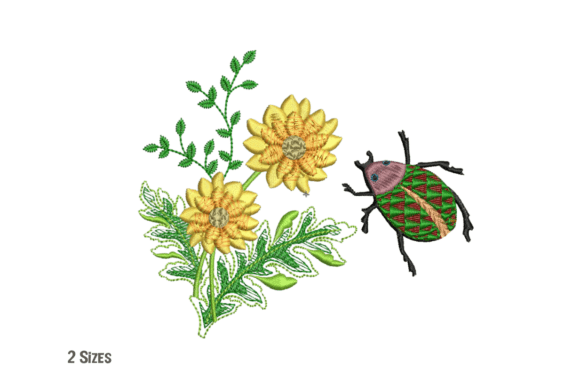
As an embroidery designer who’s stitched hundreds of boutique apparel projects, my first glance at the Sunflowers and Ladybug Embroidery Design lands with immediate warmth. It doesn’t shout—it smiles. Two radiant sunflowers anchor the composition with generous, layered petals and textured centers, while a single detailed, colorful ladybug adds whimsy and focal contrast. The layout feels intentional: not overcrowded, not sparse—just right for chest placement on a relaxed-fit sweatshirt. There’s clear attention to organic flow: the sunflower stems curve gently, leaves taper naturally, and the ladybug’s spots suggest careful digitizing rather than flat fill. This isn’t a clip-art motif; it carries stitching personality—soft satin for petals, subtle seed stitch in centers, and likely smooth outline work around the ladybug’s shell. That nuance translates directly into perceived quality in the finished product.
How It Lives on Real Sweatshirts
I tested this design conceptually across five real-world garment scenarios common to small shop product development:
- Neutral sweatshirts (heather grey, oat, cream): The design sings. Sunflower yellows and warm browns pop without clashing, and the ladybug’s red becomes a joyful punctuation mark—not overwhelming, but memorable.
- Dark fabric (navy, charcoal, black): Here, thread color contrast is critical. With rich, high-contrast thread choices (e.g., deep burgundy for the ladybug, golden yellow with orange undertones), the design reads clearly—even at 3.5"–4" width. No detail drowns.
- Pastel colors (dusty rose, mint, lavender): The playful yet grounded nature of the Sunflowers and Ladybug Embroidery Design avoids cutesiness. It reads as gentle, thoughtful, and seasonally versatile—ideal for spring/summer capsule collections.
- Oversized hoodies: At chest level, it balances proportion beautifully. Not too small to disappear, not so large it competes with silhouette. On sleeve or cuff placement? Possible—but only if scaled down thoughtfully. The ladybug’s detail may soften below 2.25", so test readability.
- Cozy seasonal apparel (fleece-lined, brushed cotton, French terry): Fabric texture matters. This design’s moderate stitch density (implied by “detailed” + “radiant” execution) should hold well—no excessive piling or tunneling—if paired with the right stabilizer.
Design Personality & Brand Alignment
The Sunflowers and Ladybug Embroidery Design leans playful, feminine, and quietly rustic—not overly botanical, not cartoonish, not minimal. It bridges cottagecore charm and modern handmade appeal. For a boutique brand, that means instant visual recognition: customers scrolling an Etsy feed will pause at its warmth and cohesion. It supports storytelling—think “slow living,” “small joys,” “backyard wonder”—without needing text. That emotional resonance builds buyer trust faster than generic florals. And because it’s rooted in nature (with a nod to Bugs as a category), it subtly signals eco-conscious values or local-grown inspiration—valuable for lifestyle branding.
Practical Designer Considerations
Before sending this machine embroidery design to production, here’s what I’d verify with my digitizer or file provider:
- Thread color guidance: Does the embroidery file include recommended thread colors—or at least PMS references? Contrast is non-negotiable on darks. A mismatched yellow or washed-out red undermines the entire mood.
- Stitch density: “Detailed” suggests fine elements (ladybug legs, petal veins). Overly dense fills on thick sweatshirt fabric can cause stiffness or puckering. Look for balanced underlay and strategic run-stitch backgrounds.
- Stabilizer strategy: Medium-weight cutaway or tear-away + topping for fleece textures. Skip lightweight stabilizers—they won’t support those sunflower curves on heavy knits.
- Hoop size & placement flexibility: Can it comfortably fit a 4"x4" hoop? That’s essential for small-shop efficiency. Also: does the design allow for slight repositioning without cropping key elements? Chest placement tolerance matters across size runs.
- Small-size readability: If you plan to offer a mini version (e.g., on pocket or sleeve), ask whether a scaled-down variant exists—or whether the original holds clarity below 3". Tiny ladybugs lose impact fast.
- Washing durability: Tight satin stitches on petals + secure lock-downs on the ladybug’s outline = long-term wear. But always request wash-test notes. A design that frays after three cycles damages your handmade product reputation.
Commercial Use & Customer Impact
This digital embroidery file isn’t just decoration—it’s a value multiplier. On a $68 sweatshirt, a well-executed Sunflowers and Ladybug Embroidery Design justifies premium pricing. Why? Because it signals craftsmanship, intention, and care—the hallmarks of a trusted small shop product. Customers don’t buy embroidery; they buy the feeling of wearing something singular. That emotional lift drives repeat purchases, Instagram tags, and organic shares. In mockup previews or printable mockup listings, this design photographs exceptionally well: natural light catches thread sheen, and the ladybug adds a delightful “find me” moment in lifestyle shots. For an Etsy seller, that translates to higher conversion and lower return rates—people love what they *feel* connected to.
Final Thought: A Thoughtful Anchor for Your Collection
The Sunflowers and Ladybug Embroidery Design works because it’s specific without being limiting. It’s cheerful but not childish, decorative but not fussy, nature-inspired but not cliché. As a custom apparel asset, it strengthens brand identity through consistency—imagine it repeated across sweatshirts, tote bags, and tea towels with cohesive thread palettes. Just remember: always confirm file specs (hoop size, format compatibility, commercial license) before cutting fabric. And when you do launch? Style it simply—a neutral sweatshirt, raw-hem jeans, sunlit backyard photo. Let the finished product speak for itself. That’s where this design truly shines.