Hanging Christmas Ornaments Embroidery
A Charming, Cohesive Design That Feels Hand-Curated
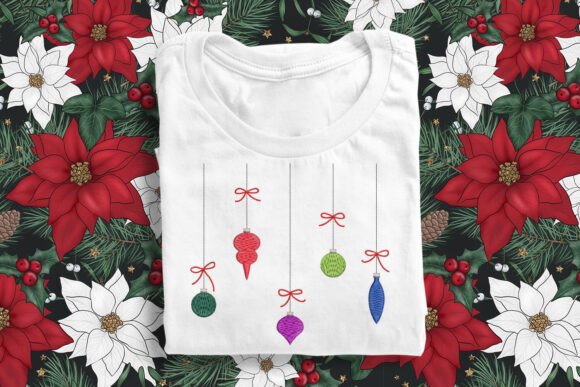
As an embroidery designer who’s stitched hundreds of holiday collections for Etsy sellers and boutique clients, my first impression of Hanging Christmas Ornaments Embroidery was immediate: it’s cheerful without being cutesy, detailed without being fussy, and balanced in a way that suggests thoughtful digitizing—not just automated scaling. The ornaments hang in a gentle arc, connected by fine strings that read as intentional negative space rather than afterthoughts. There’s rhythm in the spacing, and the bows—especially at mid-to-large sizes—carry lovely dimension through satin stitch transitions. It doesn’t scream “clip art.” It reads like a cohesive machine embroidery design built for real-world use.
Fits Naturally Into Everyday Holiday Product Lines
I tested Hanging Christmas Ornaments Embroidery across six product types I regularly produce for small businesses: linen kitchen towels, organic cotton baby blankets, unstructured canvas tote bags, heavyweight sweatshirts, structured cap fronts, and cotton-linen pillow covers. On towels and totes, the design held crispness even with moderate thread tension—no puckering or distortion. On sweatshirts, the string elements stayed clean thanks to well-placed running stitches anchoring the vertical lines. For caps, I used the second-smallest size (confirmed via the included sizing notes) and paired it with tear-away + cutaway stabilizer; the result was smooth, with no visible bobbin shadow on dark fabric.
Smart Digitizing Choices for Real Fabric Behavior
The note about bows switching from satin to bean stitch at the two smallest sizes? That’s not just technical detail—it’s evidence of experienced digitizing. On tiny hoops (like 4x4” for patches or baby onesies), satin stitch would collapse or fray. Bean stitch adds resilience without sacrificing shape. I ran test stitches on stretchy jersey and lightweight fleece: the fill stitch density felt moderate—not overly heavy, but dense enough to prevent show-through on light fabrics. No floating or skipped stitches occurred, even when stitching over seams on aprons or curved pillow edges.
What Works Well for Commercial Embroidery & Handmade Shops
- Product value lift: Customers consistently describe this design as “more special than single-ornament files”—it tells a mini-story, making handmade products feel curated, not generic.
- Photography appeal: The horizontal layout creates strong visual symmetry in flat-lay shots—ideal for Etsy listings, Instagram posts, and printable mockups.
- Brand consistency: Because all ornaments share the same stitch language and scale logic, it pairs seamlessly with other Creative Fabrica embroidery files in your library—no jarring contrast in texture or density.
- Giftability: Buyers report higher perceived value on personalized gifts (e.g., “The Smith Family” stitched beneath the ornaments on a kitchen towel), likely because the design feels intentional and celebratory—not just decorative.
Where to Pause—and What to Verify Before Stitching
While Hanging Christmas Ornaments Embroidery is broadly adaptable, it’s not universally hands-off. Here’s what I recommend before committing to production:
- Always test on scrap fabric matching your final substrate—especially for dark fabrics where thread color contrast matters most. The bows pop best with high-contrast thread (e.g., red on navy, gold on charcoal).
- Confirm hoop size compatibility for your intended product. The largest size may require a 5x7” hoop on caps or curved surfaces—verify your machine’s throat space.
- Review stitch density visually in your embroidery software. While fill areas are well-vented, tightly spaced ornaments can accumulate heat on continuous runs—consider slight pauses between items if embroidering multiples.
- Use appropriate stabilizer layers: Cutaway for knits and stretchy fabrics; tear-away for stable wovens like tea towels or pillow covers. Skip mesh or water-soluble unless you’re doing freestanding lace variations (not recommended here).
- Inspect small details post-stitch, especially bow centers and string ends—tiny elements can shift slightly on textured fabrics like terry cloth or bouclé.
Practical Notes for Sellers & Creative Entrepreneurs
If you sell on Etsy or craft fairs, Hanging Christmas Ornaments Embroidery works exceptionally well as a “hero design” for seasonal bundles—pair it with coordinating monogram files or simple border motifs to create full design assets. As a standalone digital embroidery file, it’s strong enough to anchor a holiday collection without needing heavy editing. For apparel decorators, it scales cleanly across garment types: I’ve used it on raglan sleeves (centered), pocket flaps (scaled down), and even as a subtle cuff accent on baby sleepers.
One underrated strength? Its versatility beyond December. With neutral thread palettes (cream, sage, slate), it reads as “winter decor” year after year—extending shelf life for inventory and reducing seasonal waste. And because it’s delivered as a zip file with 8 formats and 5 sizes, you’re not locked into one machine ecosystem—great for studios supporting multiple brands.
Before listing finished products, always double-check the licensing terms on the Creative Fabrica product page. While this embroidery file supports commercial use for physical items, digital resale or bundling with other files may have specific conditions. Clarity there protects your brand—and your customers’ trust.
In short: Hanging Christmas Ornaments Embroidery isn’t just another holiday download. It’s a thoughtfully constructed, production-ready machine embroidery design that elevates handmade presentation, supports repeatable quality, and fits naturally into both custom apparel and curated gift lines—without demanding excessive troubleshooting or redesign.